Prologue
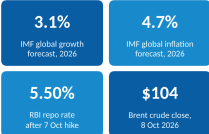
- The IMF’s October 2026 World Economic Outlook sees global growth slowing to 3.1% in 2026 from 3.5% in 2025, while global inflation is projected to rise to 4.7%, up from 4.1% last year.
- The RBI raised the repo rate by 25 bps to 5.50% on 7th October 2026, its first hike in nearly three years, as CPI inflation climbed to 5.54% in September
- Brent crude closed at $104.28 a barrel on 8th October as tanker attacks in the Strait of Hormuz resumed. Oil flows through the strait are still about 30% below pre-war levels.
Introduction
A year ago, the debate was about how fast central banks could cut rates. The war involving Iran that began in late February 2026 changed that. It effectively shut the Strait of Hormuz for weeks, pushed oil above $100 and turned a year of expected easing into one of renewed tightening. The Federal Reserve, the European Central Bank, the Bank of Japan and now the Reserve Bank of India have all raised rates since June.
Because this is a supply shock, it raises prices and slows growth at the same time. India is still the fastest-growing major economy but imported inflation, a weaker rupee and rising bond yields are now testing its buffers. This report looks at how the shock is moving through supply chains into prices, how central banks are responding, what it means for growth, and what Indian businesses should do.
Understanding the Supply Chain Shocks of 2026
A supply shock is any event that suddenly raises the cost, or reduces the availability, of the inputs businesses need to produce and move goods. The shocks shaping 2026 fall into five groups:
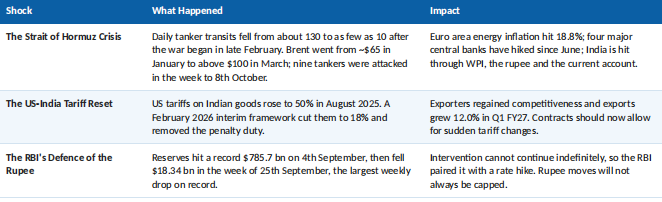
- Energy and Chokepoints: The Strait of Hormuz normally carries about one-fifth of the world’s oil. When traffic collapsed in March, Brent crossed $100 for the first time since 2022.
- Trade Policy: US tariffs on Indian goods rose to 50% in August 2025 before a February 2026 framework cut them to 18%, showing how fast landed costs can swing.
- Freight and Logistics: Container, tanker and air freight rates have jumped, transit times have lengthened and ports face congestion as ships reroute.
- Export Controls: Restrictions on semiconductors, rare earths and critical minerals raise costs for electronics, EV and defence supply chains.
- Currency and Capital Flows: Risk aversion has pulled money toward the dollar, so every barrel of imported oil costs India more in rupee terms.
How Supply Shocks Travel into Inflation
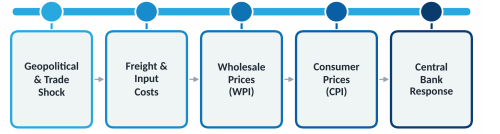
1. Freight and Input Costs Move First
The New York Fed’s Global Supply Chain Pressure Index rose to 1.28 in September, against a long-run average of zero and a reading of -0.21 as recently as November 2025. It peaked at 1.81 in May, at the height of the Hormuz disruption. Container freight tells the same story
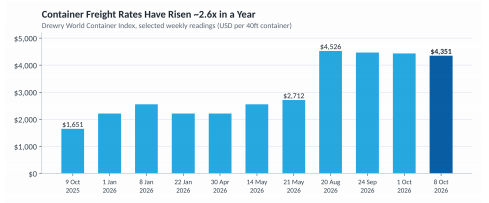
Key Observations:
- Freight has more than doubled in a year: The index stood at $4,351 on 8th October against about $1,651 a year earlier.
- The big jump came after May: Rates were broadly flat at $2,200 to $2,700 until May, then rose sharply as rerouting and security costs built up.
- Recent dips are seasonal: The last two weekly declines reflect China’s Golden Week holiday, and carriers are already pushing rate increases for late October.
2. Energy Prices Feed Into Everything
Oil is the input that touches every supply chain, from fuel and freight to plastics, fertiliser and chemicals. Brent has swung sharply with each turn in the Hormuz crisis:

3. Wholesale and Retail Prices Follow
India’s WPI inflation jumped to 11.39% in September from 9.9% in August, led by energy, metals and chemicals. Retail prices react last, and the wide gap between WPI and CPI (5.54%) suggests more pass-through is still to come.
Global Inflation Trends
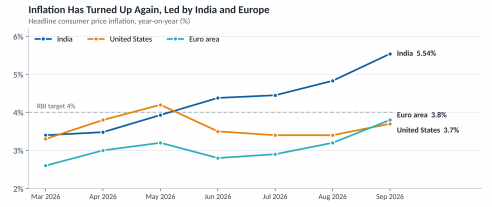
Key Observations:
- India has moved above target: CPI rose every month from 3.40% in March to 5.54% in September, its highest since October 2024, and has stayed above the RBI’s 4% target for four months. Food inflation reached 7.74%, and rural inflation (6.08%) is well above urban (4.88%).
- Europe is the most exposed to energy: Euro area inflation hit 3.8% in September, the highest since 2023, with energy prices up 18.8%. Core inflation was a milder 2.5%.
- US inflation has turned up again: After peaking at 4.2% in May, US CPI eased to 3.4% before rising to 3.7% in September on record petrol prices.
- This is an imported cost shock: Core inflation has risen far less than headline inflation, which points to energy and food rather than overheating demand.
Central Bank Policy Responses
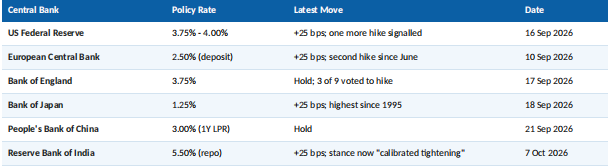
Most central banks spent 2025 cutting rates. Since June 2026, four of the six below have raised them, and the Bank of England is one vote short of joining them. China is the only major economy still leaning toward support.
Reserve Bank of India
The RBI’s Monetary Policy Committee voted unanimously to raise the repo rate from 5.25% to 5.50%. The Standing Deposit Facility moves to 5.25% and the Marginal Standing Facility to 5.75%. The RBI raised its FY27 inflation projection to 5.2% and expects CPI to peak near 6.0% in the October to December quarter.
Impact:
- Repo-linked (EBLR) loans will reprice at their next reset; MCLR-linked loans follow with a lag.
- ICRA has said another hike looks likely in December, so borrowers should not plan for a quick reversal.
- Higher US rates support the dollar and add pressure on the rupee and on dollar borrowings linked to SOFR.
GDP Growth Forecasts
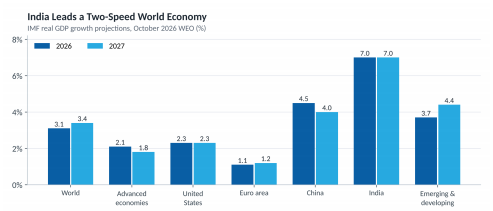
Key Observations:
- India is the clear outlier: The IMF raised India’s 2026 forecast by 0.6 points to 7.0%. Real GDP grew 7.8% in April to June 2026, with investment up 11.9%, and the RBI now projects 7.1% for FY27.
- China is being marked down: Its forecast was cut to 4.5% for 2026 on weak domestic demand.
- Growth is concentrated: The IMF notes that just 32 countries account for 95% of global growth, with energy importers outside the AI boom bearing the cost.
Impact on Indian Businesses
- Cost of Debt Is Rising Again: The 10-year G-Sec yield, the benchmark for corporate bonds, has climbed from a 52-week low of about 6.48% to around 7.35%. Companies refinancing in H2 FY27 will likely pay more than they budgeted.
- Working Capital Is Under Pressure: With WPI above 11% and freight costs more than double last year’s level, the same inventory now ties up more cash.
- Currency Risk Is Back: Forex reserves fell from a record $785.7 billion on 4th September to $734.6 billion on 2nd October at the RBI defended the rupee. Unhedged importers and foreign currency borrowers are exposed.
- Exporters Have a Window: Lower US tariffs and a weaker rupee have improved pricing for engineering, textiles, pharma and chemicals exporters, provided they can secure shipping capacity
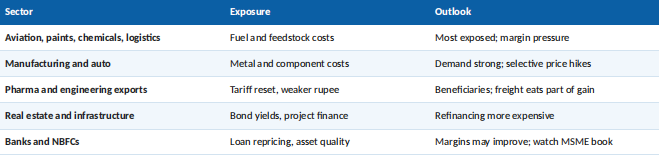
Sector View
Case Studies: Three Shocks of 2026
The Road Ahead

What Businesses Should Do Now
- Review the debt book: Map loans by benchmark and reset date, and consider fixing rates or refinancing expensive debt early.
- Hedge currency exposure: Importers and ECB borrowers should revisit hedge ratios.
- Strengthen working capital lines: Invoice discounting, TReDS and vendor finance can release cash tied up in receivables and inventory.
- Diversify suppliers and routes: Keep alternatives and slightly larger buffer stocks of critical inputs.
Conclusion
A single chokepoint in the Gulf has reversed the global rate-cutting cycle, lifted inflation and redrawn growth forecasts. India has absorbed the shock better than most, but with inflation above target, reserves falling and borrowing costs rising, its margin for error is narrower than at the start of the year. Businesses that review their debt, protect their working capital and plan for more than one scenario will be best placed when conditions improve.